
Getting Started
When Should My Student Start Preparing for the SAT?
When to start SAT prep — school math vs. test-specific practice, a practical sophomore-to-junior timeline, and how to work backward from applications.
Direct answer: Start serious, test-specific SAT prep when the student has enough algebra under their belt to practice productively — often late sophomore year or early junior year — and work backward from when scores need to be on applications. “As early as possible” is not automatically better; grinding the digital SAT before the content is ready mostly burns motivation.
Facts below are current as of August 2026. Structure and timing change — when in doubt, check College Board and your student’s school counseling calendar for local test dates and score-release timing.
Two different clocks
Parents often mix two timelines:
| Clock | What it is | When it runs |
|---|---|---|
| School math | Algebra, geometry, and advanced algebra fluency that every SAT Math question assumes | Ongoing from middle school through junior year courses |
| Test-specific prep | Timed Bluebook practice, adaptive pacing, question formats, and targeted review of SAT domains | Usually concentrated in the months before official sittings |
Strong school math is the foundation. SAT-specific prep is how that foundation gets converted into a score under digital, timed conditions. Starting “SAT prep” in ninth grade by buying commercial books often means practicing skills the student has not learned yet — which feels like failure when it is really sequencing.
A practical calendar (not a mandate)
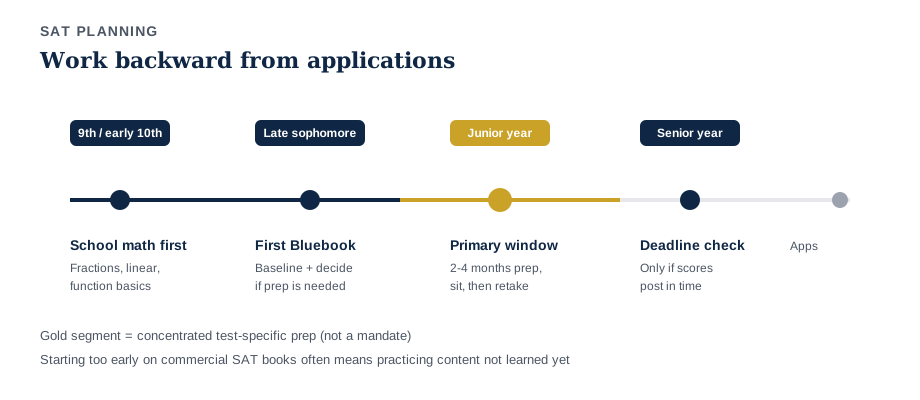
There is no single correct start date. This pattern is common for students aiming at a competitive application cycle:
| Stage | Typical focus |
|---|---|
| Freshman / early sophomore | School math first. Fix fragile fractions, linear equations, and function basics. Optional: light familiarity with PSAT-style questions if the school offers them — not a full SAT campaign. |
| Late sophomore | A common window to take a first official-style digital practice test in Bluebook, see the baseline, and decide whether junior-year testing needs structured prep. |
| Junior year | Primary testing window for most students. Build a prep block (often 2–4 months of consistent practice), sit the SAT, then retake if the first score and the target still diverge. |
| Senior year | Still possible if scores will arrive before application deadlines (including early-action / early-decision dates). Do not assume a late fall sitting will post in time for every school on the list — check each college’s policy. |
Sophomore year as a “start window” means baseline and planning, not necessarily daily tutoring. Junior year is when most of the timed practice and official sittings should land.
Plan backward from deadlines
Work from the application calendar, not from anxiety:
- List schools and whether they are test-optional, test-required, or score-blind for the cycle you care about.
- Note early vs. regular deadlines and when each school needs scores on file.
- Count backward through College Board score-release timing and one possible retake.
- Place the first official sitting early enough that a retake is still useful — not the week applications are due.
If the student is applying early decision with a hard score need, junior spring (or earlier) is usually safer than senior October. If the student is still building Algebra II fluency, delaying the first official sitting until the content is ready often beats an early low score that only adds stress.
What “SAT Math prep” actually means in 2026
The digital SAT Math section is 44 questions in 70 minutes, split into two modules of 22 questions / 35 minutes. Module 2 is adaptive — harder or easier based on Module 1. A calculator is allowed throughout (Bluebook Desmos or an approved handheld) (College Board structure; calculator policy).
That design affects when prep is useful:
- Students still shaky on linear equations will struggle regardless of how early they start Bluebook drills.
- Students with solid Algebra II can often make real gains in a focused junior-year block because practice matches the interface and adaptive routing.
- Early “prep” that is really just unfinished algebra homework is school support — call it that, and do it without SAT branding.
Free resources that actually help
Start here before buying a stack of commercial books:
- Khan Academy — Official Digital SAT Prep partnership with College Board; also the best free place to rebuild weak algebra.
- Bluebook — Official full-length digital SAT practice from College Board (timed, adaptive modules).
Official practice beats random worksheets because the scoring, interface, and question style match test day.
When a tutor is worth it (and when it isn’t)
If a motivated student can stay consistent with Bluebook + Khan Academy, diagnose misses, and improve without appointments, they may not need tutoring.
A tutor is more useful when:
- The baseline practice test shows the same error types repeating and the student cannot explain why
- Practice only happens when someone else puts it on the calendar
- Adaptive Module 2 routing or pacing is leaving points on the table
- School math gaps are blocking SAT-specific work, and the family wants a clear sequence
Math Test Prep focuses on the math side of exam prep. Full multi-section SAT coaching under one roof may fit better elsewhere if verbal is equally the bottleneck.
Next step
If you want a realistic timeline for a first sitting, a retake, and how much Math prep the goal actually requires, book a free 15-minute consultation or send a note through the contact form.
Related: Should My Student Take the SAT or ACT? · SAT Math vs. ACT Math · What’s Actually on the SAT Math Section?