
SAT & ACT
What's Actually on the SAT Math Section?
A clear map of digital SAT Math — four content domains, calculator rules, adaptive modules, and how to practice with Bluebook and Khan Academy.
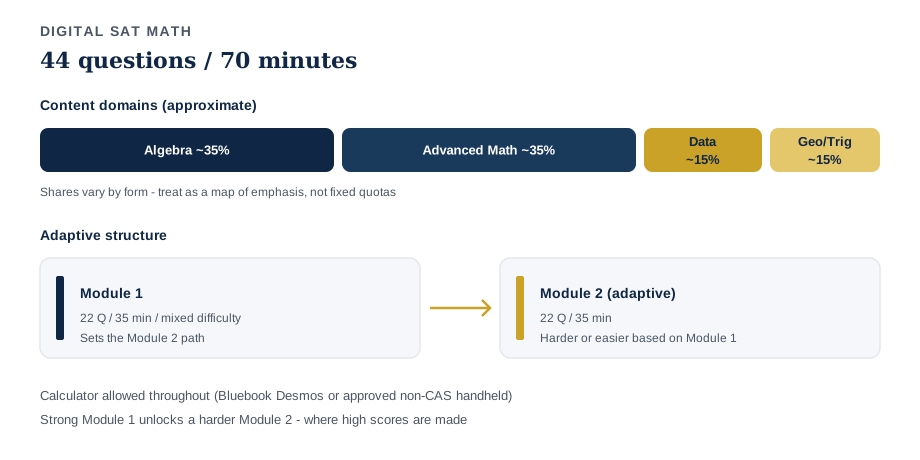
Direct answer: Digital SAT Math is 44 questions in 70 minutes, split into two 22-question / 35-minute modules. Module 2 is adaptive. A calculator is allowed on every question. Content is framed as four domains: Algebra, Advanced Math, Problem-Solving & Data Analysis, and Geometry & Trigonometry — not a mysterious grab bag.
Facts below are current as of August 2026. Structure and timing change — when in doubt, check College Board and the PSAT/SAT Suite math overview (same domain framework across the SAT Suite).
Structure at a glance
| Digital SAT Math | |
|---|---|
| Questions | 44 |
| Time | 70 minutes |
| Modules | Two equal modules · 22 Q / 35 min each |
| Adaptive? | Yes — Module 2 harder or easier based on Module 1 |
| Answer formats | Mostly multiple choice; some student-produced (typed) answers |
| Calculator | Allowed throughout (Bluebook Desmos or approved non-CAS handheld) |
Module 1 mixes easy, medium, and hard items. A strong Module 1 unlocks a harder Module 2 — which is where high scores are made. Wild guessing early can route a student into an easier second half and cap their ceiling (College Board structure).
The four domains
College Board groups SAT Suite Math into four domains. Exact counts vary by form; treat shares as approximate maps of emphasis, not guaranteed quotas.
| Domain | Rough share | Typical topics |
|---|---|---|
| Algebra | ~35% ~13–15 Q |
Linear equations and inequalities; systems of linear equations; linear functions; interpreting slope and intercepts in context |
| Advanced Math | ~35% ~13–15 Q |
Equivalent expressions; nonlinear equations; quadratics; exponentials; polynomials; nonlinear functions |
| Problem-Solving & Data Analysis | ~15% ~5–7 Q |
Ratios, rates, proportions, percentages; units; one- and two-variable data; scatterplots; probability and conditional probability; margins of error / evaluating claims (as framed on the Suite) |
| Geometry & Trigonometry | ~15% ~5–7 Q |
Area, volume; lines, angles, triangles; right-triangle trigonometry; circles (equations and properties as tested on the Suite) |
Algebra (deep dive)
Expect fluency, not trivia:
- Solving and graphing linear equations and inequalities
- Systems (substitution, elimination, or graphing intuition)
- Function notation and interpreting linear models in word problems
- Recognizing when a relationship is linear vs. not
Weaknesses here show up everywhere else — Advanced Math and data questions often rest on linear fluency.
Advanced Math (deep dive)
This is where many solid Algebra I students get surprised:
- Factoring and rewriting expressions
- Quadratic equations and graphs (including vertex / intercept meaning)
- Exponential growth and decay in context
- Polynomials and rational equations at the Suite’s stated depth
- Connecting equations, tables, and graphs for nonlinear functions
Problem-Solving & Data Analysis (deep dive)
Less “geometry olympiad,” more careful reading of quantitative information:
- Percent change, proportional reasoning, unit rates
- Two-way tables and basic probability
- Scatterplots, lines of best fit, and describing relationships
- Spotting what a graph or study claim does — and does not — support
Geometry & Trigonometry (deep dive)
A smaller share than many parents expect, but still scored:
- Area and volume formulas in applied settings
- Angle relationships and triangle properties
- Right-triangle trig (sine, cosine, tangent) as used on the Suite
- Circle relationships that appear in algebra/geometry crossover items
Calculator: allowed does not mean required
A calculator is allowed on every Math question. Bluebook includes Desmos; students may also bring an approved non-CAS calculator (calculator policy).
Some items are still faster with mental math or a quick sketch. Students who lean on the calculator for every arithmetic step often run short on time — especially if Desmos exploration replaces recognizing structure.
How to practice without wasting months
- Take a full Bluebook practice test timed — get a real baseline and see Module 2 routing.
- Tag misses by domain (Algebra vs. Advanced Math vs. Data vs. Geometry/Trig), not by “careless.”
- Rebuild weak skills on Khan Academy (Official Digital SAT Prep) with short, focused sets.
- Retake official practice; watch whether the same domain keeps leaking points.
- Only then add commercial books or tutoring if official practice has stalled.
Official practice beats random worksheets because the interface, adaptive modules, and answer entry match test day.
Free resources that actually help
- Khan Academy — Official Digital SAT Prep partnership with College Board.
- Bluebook — Official full-length digital SAT practice from College Board.
Start there before a bookstore cart of third-party materials.
When a tutor is worth it (and when it isn’t)
If a student can diagnose domain gaps, stay consistent, and improve on Bluebook + Khan Academy alone, they may not need a tutor.
A tutor is more useful when:
- The same domain errors repeat and the student cannot explain the underlying rule
- Adaptive Module 2 performance is inconsistent with Module 1 effort
- Foundations (fractions, linear equations, function notation) are blocking Advanced Math
- Practice only happens with an appointment on the calendar
Math Test Prep focuses on SAT Math (and related exam math sections) — not full Reading & Writing coaching under one roof.
Next step
If you want a domain-level read on a practice test and a focused Math plan, book a free 15-minute consultation or send a note through the contact form.
Related: SAT Math vs. ACT Math · When Should My Student Start Preparing for the SAT? · Should My Student Take the SAT or ACT?