
SAT & ACT
SAT Math vs. ACT Math
A practical comparison of SAT Math and ACT Math — timing, structure, calculator rules, and content — so you can choose with a practice test, not a stereotype.
Direct answer: Neither math section is “easier.” They reward slightly different habits. The reliable way to choose is to take a full official practice SAT and a full official practice ACT under timed conditions, then compare the math scores and how the student felt pacing. Colleges that accept one almost always accept the other.
Facts below are current as of August 2026. Structure and timing change — when in doubt, check College Board and ACT.
Side-by-side at a glance
| SAT Math | ACT Math | |
|---|---|---|
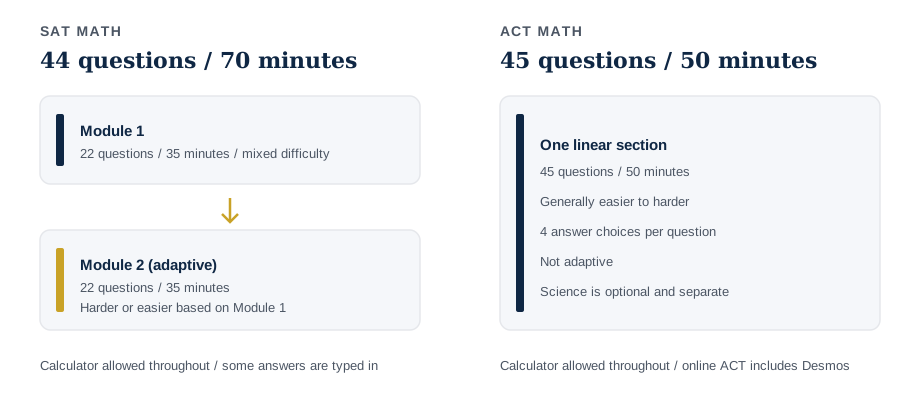
| Questions | 44 | 45 (students see all 45; ACT reports 41 as scored) |
| Time | 70 minutes | 50 minutes |
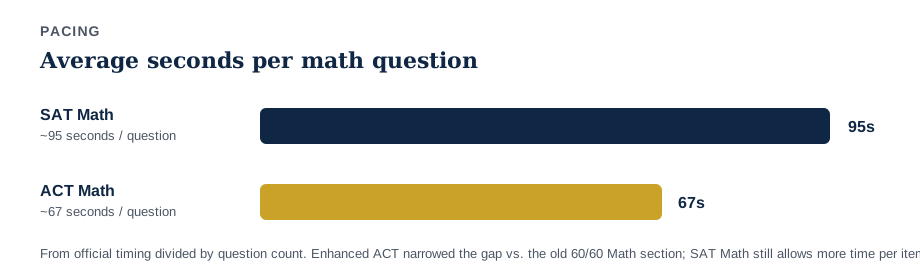
| Avg. time / question | ~95 seconds | ~67 seconds |
| Format | Two modules · second module adaptive | One linear section |
| Answer format | Multiple choice + some student-produced (typed) answers | Multiple choice · 4 choices |
| Calculator | Allowed throughout (Bluebook Desmos or approved handheld) | Allowed throughout (online ACT includes Desmos; CAS banned) |
| Content framing | Algebra · Advanced Math · Data analysis · Geometry & Trig | Number & Quantity · Algebra · Functions · Geometry · Stats & Probability (+ Integrating Essential Skills / Modeling) |
| Adaptive? | Yes | No |
What the structure feels like
SAT Math
The digital SAT Math section is 44 questions in 70 minutes, split into two equal modules of 22 questions / 35 minutes. Module 1 mixes easy, medium, and hard items. Module 2 gets harder or easier based on Module 1 performance (College Board structure).
That adaptive design matters for preparation: a strong Module 1 unlocks a harder Module 2 — which is where high scores are made. Students who guess wildly early can route themselves into an easier second half and cap their ceiling.
A calculator is allowed on every Math question. Bluebook includes Desmos; students may also bring an approved non-CAS calculator (calculator policy). Some questions are still faster without one.
ACT Math
Enhanced ACT Math is 45 questions in 50 minutes — one continuous section, not adaptive (Enhanced ACT FAQs; Preparing for the ACT 2025–2026). Questions generally run easier to harder. Each item has four answer choices (legacy ACT Math had five).
Important context for the whole exam, not just Math: the Composite is now English + Math + Reading. Science is optional and does not enter the Composite. Do not choose the ACT because “it has science” unless a specific program wants that score.
A calculator is allowed throughout Math. Online testing includes Desmos; CAS calculators are prohibited.
Content: what each section emphasizes
Exact question quotas vary by form. Use this as a map of emphasis, not a shopping list.
SAT Math domains
College Board groups SAT Suite Math into four domains:
| Domain | Rough share | What it usually looks like |
|---|---|---|
| Algebra | ~35% ~13–15 Q |
Linear equations & inequalities, systems, linear functions |
| Advanced Math | ~35% ~13–15 Q |
Quadratics, exponentials, polynomials, nonlinear equations & functions |
| Problem-Solving & Data Analysis | ~15% ~5–7 Q |
Ratios, percentages, rates, tables, graphs, basic stats & probability |
| Geometry & Trigonometry | ~15% ~5–7 Q |
Area/volume, triangles, circles, right-triangle trig |
SAT Math rewards careful reading of what the question is actually asking, fluency with algebra, and comfort entering answers (not only picking A–D).
ACT Math reporting categories
ACT describes Math as skills typically learned through the beginning of grade 12, organized roughly as:
| Category | Rough share |
|---|---|
| Preparing for Higher Math | ~80% |
| — Number & Quantity | 10–12% |
| — Algebra | 17–20% |
| — Functions | 17–20% |
| — Geometry | 17–20% |
| — Statistics & Probability | 12–15% |
| Integrating Essential Skills | ~20% |
| Modeling | ≥ 20% (cross-cutting label, not a separate topic list) |
ACT Math often feels broader and faster: more items, less time each, and a wider sprinkling of geometry/trig and pre-algebra fluency mixed with later high-school topics.
How to choose without guessing
Stereotypes (“SAT is for verbal kids,” “ACT is for science kids”) are a weak way to pick a test — and Science is no longer even required for an ACT Composite.
A better process:
- Take one full official digital SAT practice test in Bluebook (timed).
- Take one full official enhanced ACT practice test (timed).
- Compare Math scores and the student’s experience: Where did time run out? Which wrong answers were careless vs. content gaps?
- Factor in the rest of each exam (Reading & Writing vs. English/Reading, and whether optional Science is worth the extra sitting).
- Commit to one primary test for preparation. Dabbling in both forever usually costs focus.
Some students score similarly on both. Some clearly prefer one. A few struggle on both — that usually means the issue is foundations or pacing habits, not the brand name on the booklet.
Free resources that actually help
Start here before buying a stack of commercial books:
- Khan Academy — Official Digital SAT Prep partnership with College Board; also excellent for rebuilding weak algebra skills that both tests punish.
- Bluebook — Official full-length digital SAT practice from College Board.
- ACT free online practice — Enhanced-format practice on act.org; plus the Preparing for the ACT guide.
Official practice beats random worksheets because the scoring, interface, and question style match test day.
When a tutor is worth it (and when it isn’t)
If a student can diagnose misses, stay accountable, and grind official practice with a book or AI as a second explanation, they may not need tutoring.
A tutor is more useful when:
- The same error types keep showing up and the student cannot explain why
- Practice is inconsistent without an appointment on the calendar
- Adaptive SAT routing or ACT pacing is leaving points on the table
- Foundations (fractions, linear equations, function notation) are blocking everything else
Math Test Prep teaches the math sections of these exams — not the full multi-section package. If you need full SAT/ACT verbal + science coaching under one roof, a general test-prep company may fit better. If the bottleneck is Math, that is our lane.
Next step
If you want a clear read on which test fits and how much Math prep the goal actually requires, book a free 15-minute consultation or send a note through the contact form.
Related: When Should My Student Start Preparing for the SAT? · Should My Student Take the SAT or ACT? · What’s Actually on the SAT Math Section?