
GRE
What Math Is on the GRE?
What’s on GRE Quant — Arithmetic, Algebra, Geometry, and Data Analysis, adaptive section timing, question types, and how to prepare.
Direct answer: GRE Quantitative Reasoning tests high-school-level Arithmetic, Algebra, Geometry, and Data Analysis — not trigonometry-heavy coursework and not calculus. You get 27 questions in 47 minutes across two section-level adaptive Quant sections, plus an on-screen calculator. Prepare with ETS materials and Khan Academy’s GRE math videos before anything exotic.
Facts below are current as of August 2026. Structure and timing change — when in doubt, check ETS Quantitative Reasoning content and GRE test structure.
Structure at a glance
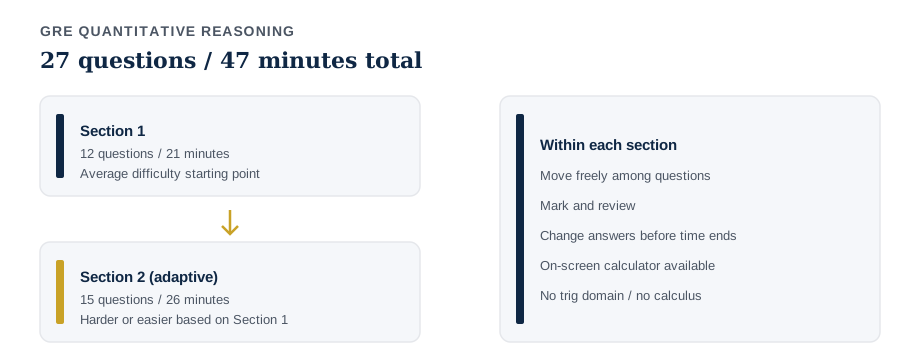
| GRE Quantitative Reasoning | |
|---|---|
| Total | 27 questions / 47 minutes |
| Section 1 | 12 questions / 21 minutes |
| Section 2 | 15 questions / 26 minutes |
| Adaptive? | Section-level — Section 2 difficulty depends on Section 1 performance |
| Within a section | Move freely, mark, review, change answers |
| Calculator | On-screen calculator provided |
| Trig / calculus? | Not part of the Quant content framework |
Scoring considers how many you get right and the difficulty of the sections you saw. A strong Section 1 matters.
Content: four areas (no calculus)
Per ETS, Quant draws on:
| Area | What it usually includes |
|---|---|
| Arithmetic | Properties of integers; fractions, decimals, percents; ratios and proportions; radicals and exponents; counting methods; sequences (as framed by ETS) |
| Algebra | Operations with exponents; factoring and simplifying; relations, functions, equations, inequalities; linear and quadratic equations; word problems; coordinate geometry (as framed by ETS) |
| Geometry | Lines, circles, triangles (including isosceles and equilateral), quadrilaterals, polygons; 3-D figures; area, perimeter, volume; Pythagorean theorem; angle measure. Figures are not necessarily drawn to scale unless stated |
| Data Analysis | Descriptive statistics (mean, median, mode, range, standard deviation); interpretation of tables and graphs; elementary probability; counting; data distributions / random variables at the ETS-stated depth |
Not on the menu: trigonometry as a major domain, and calculus. If a review book spends chapters on derivatives, you are studying the wrong exam.
Details and examples: ETS — Quantitative Reasoning.
Question types
Expect a mix of:
| Type | What you do |
|---|---|
| Quantitative Comparison (QC) | Compare Quantity A and Quantity B (or determine relationship / need more information) |
| Multiple Choice — one answer | Select a single correct choice |
| Multiple Choice — one or more | Select all that apply (partial credit rules follow ETS scoring) |
| Numeric Entry | Type an integer or decimal (and fraction format where the UI allows) |
| Data Interpretation | Sets of questions based on the same table or graph |
QC rewards careful reasoning about relationships, not always full computation. Data Interpretation rewards accurate reading of charts under time pressure.
Calculator: helpful, not a crutch
An on-screen calculator is available on Quant. Many items are still faster with estimation, number sense, or algebraic structure. Students who punch every step often lose the pacing battle on Section 1 — and Section 1 sets Section 2’s difficulty.
How to prepare without overbuilding
- Download / use ETS Math Review and official Quant practice (ETS prepare hub).
- Use Khan Academy GRE math videos for weak topics (arithmetic through data analysis).
- Practice QC separately — the format trips people who only drill standard multiple choice.
- Do timed Section 1 + Section 2 blocks (12Q/21min + 15Q/26min), not only untimed problem sets.
- Add a tutor only if official practice stalls or accountability collapses.
Free resources that actually help
- ETS — Official Quant content descriptions, Math Review, and practice questions.
- Khan Academy — GRE Quantitative video lessons for skill rebuilding.
Official materials beat random hard problems from unrelated contests.
When a tutor is worth it (and when it isn’t)
If you can finish ETS practice, learn from misses, and stay consistent with Khan Academy, you may not need a tutor.
A tutor is more useful when:
- QC strategies are not clicking after honest practice
- Arithmetic/algebra foundations are leaking into every Data Interpretation set
- Section 1 timing is consistently weak (which then caps Section 2)
- Accountability is the real problem — not a shortage of PDFs
Math Test Prep focuses on Quant (and related exam math). Full Verbal + Analytical Writing packages live elsewhere.
Next step
If you want a clear read on whether GRE Quant prep needs tutoring or just a tighter ETS + Khan plan, book a free 15-minute consultation or send a note through the contact form.
Related: Tutor, AI, or Test-Prep Books — What’s Best? · Can AI Replace a Math Tutor? · What’s Actually on the SAT Math Section?