
GED
How to Prepare for GED Math
How to prepare for GED Math — topics, Part 1/Part 2 calculator rules, timing, and a study plan with Khan Academy and GED Ready.
Direct answer: Treat GED Math as its own exam — Mathematical Reasoning — not a mini-SAT. Study Basic Math, Geometry, Basic Algebra, and Graphs & Functions; practice with the formula sheet; and get comfortable with Part 1 (no calculator) and Part 2 (TI-30XS). Use Khan Academy for skills and GED Ready for a realistic check before you pay for the real test.
Facts below are current as of August 2026. Policies and forms change — when in doubt, check GED.com and official GED Testing Service study materials.
What the GED is (quick orientation)
The GED is four separate subject tests. You can take them one at a time:
- Reasoning Through Language Arts
- Mathematical Reasoning
- Science
- Social Studies
You do not have to sit all four on the same day. Passing Math is independent of passing the others — which is good news if Math is the bottleneck.
Mathematical Reasoning at a glance
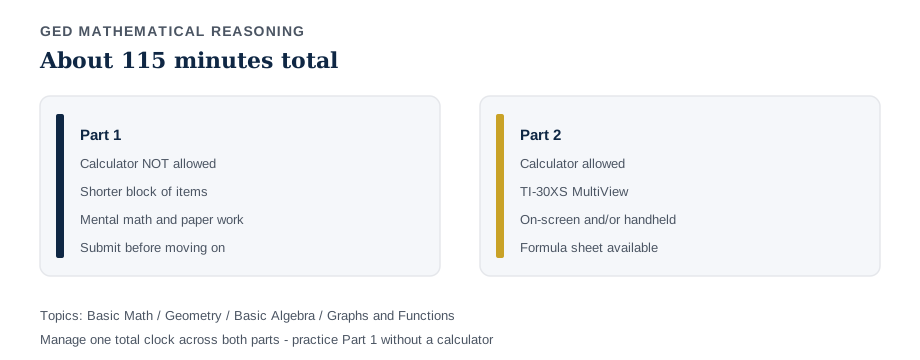
| GED Mathematical Reasoning | |
|---|---|
| Time | About 115 minutes total (parts are not separately timed like two mini-exams; manage the clock yourself) |
| Parts | Part 1: calculator not allowed · Part 2: calculator allowed |
| Calculator | TI-30XS MultiView (on-screen and/or handheld per current GED rules) |
| Tools | Formula sheet + calculator reference sheet provided |
| Topic framing | Basic Math · Geometry · Basic Algebra · Graphs and Functions |
| Emphasis (approx.) | Quantitative problem solving ~45% · Algebraic problem solving ~55% |
| Question count | Forms vary; plan as roughly ~46 questions if you need a ballpark — confirm on current GED materials rather than memorizing a single number |
| Item types | Multiple choice plus tech-enhanced items (e.g., drag-and-drop, fill-in, drop-down, hot spot — as offered on the form) |
Sources for structure and tools: GED.com and GED Testing Service math study / educator guides.
What to study (by topic)
| Area | Focus on |
|---|---|
| Basic Math | Operations with whole numbers, fractions, decimals, percents; ratios and proportions; word problems |
| Geometry | Perimeter, area, volume; angle relationships; Pythagorean theorem; using the formula sheet instead of memorizing everything |
| Basic Algebra | Expressions, equations, inequalities; linear relationships; solving for unknowns in context |
| Graphs & Functions | Reading tables and graphs; slope/rate ideas; plotting and interpreting simple functional relationships |
You are not studying for calculus. You are studying for careful reading of workplace- and classroom-style quantitative problems under time pressure.
Calculator strategy (Part 1 vs. Part 2)
Part 1 is short relative to Part 2 but high stakes for confidence: no calculator. Practice mental math, fraction sense, and simple algebra by hand.
Part 2 allows the TI-30XS. Learn that calculator before test day — not during the clock. GED provides a reference sheet; still, fluency beats hunting menus.
Between parts, testing centers typically allow a brief pause to retrieve a handheld calculator if you are using one; confirm current local procedures when you schedule.
A practical prep plan
- Take GED Ready® for Mathematical Reasoning (official practice) to get a baseline and see if you are “likely to pass” territory.
- Build a weak-topic list from that report (fractions? linear equations? graphs?).
- Rebuild those skills on Khan Academy with short daily sets — mastery over marathon weekends.
- Practice with the formula sheet visible, the way test day works.
- Drill a handful of no-calculator items every week so Part 1 does not surprise you.
- Retake GED Ready when your study block is done; schedule the real Math test when practice says you are ready.
Skip random YouTube difficulty flexes that do not match GED item style.
Free resources that actually help
- GED.com — Official study guides, calculator practice, and scheduling information.
- GED Ready — Official practice test aligned to the real exam.
- Khan Academy — Excellent free skill rebuilding for arithmetic, algebra basics, and graph reading.
Official practice beats piles of unrelated worksheets.
When a tutor is worth it (and when it isn’t)
If you can stay consistent with Khan Academy + GED Ready and your practice results are climbing toward a pass, you may not need a tutor.
A tutor is more useful when:
- Anxiety or life schedule keeps derailing solo study
- Part 1 (no calculator) collapses even when Part 2 feels fine
- Algebra foundations are blocking every practice form
- You need someone to turn a GED Ready report into a week-by-week plan
Math Test Prep can help with GED Math specifically. Full four-subject GED coaching may fit better with a broad adult-education program if Language Arts / Science / Social Studies also need heavy work.
Next step
If you want a straightforward Math-only plan toward scheduling the real GED Mathematical Reasoning test, book a free 15-minute consultation or send a note through the contact form.
Related: Tutor, AI, or Test-Prep Books — What’s Best? · Can AI Replace a Math Tutor? · What Math Is on the GRE?