
ASVAB
What Is the ASVAB and Who Should Take It?
A plain-English overview of the ASVAB — military recruiting, career exploration, AFQT scoring, line scores, and which math subtests matter.
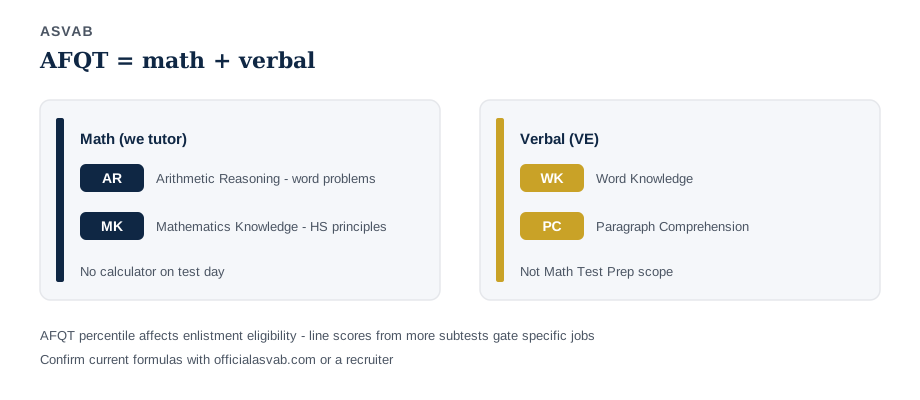
Direct answer: The ASVAB (Armed Services Vocational Aptitude Battery) is a multi-subtest exam used for military recruiting and, in schools, for career exploration. Enlistment eligibility leans on the AFQT, built from Arithmetic Reasoning (AR), Mathematics Knowledge (MK), Word Knowledge (WK), and Paragraph Comprehension (PC). Job qualification uses additional line scores. The math we tutor for this exam is AR + MK, and there is no calculator.
Facts below are current as of August 2026. Policies differ by service and update over time — when in doubt, check Official ASVAB and your recruiter or school counselor for the version you will take (CAT-ASVAB vs. paper).
Who typically takes it
| Path | Why the ASVAB shows up |
|---|---|
| Enlisting | Required (or accepted) as part of qualification for military service; AFQT and line scores matter for eligibility and jobs |
| Students (career exploration) | Many high schools offer the ASVAB CEP for career planning — not automatically an enlistment commitment |
| Career changers exploring service | Same subtests; talk to a recruiter about current rules, retakes, and score validity |
Taking a school ASVAB for career exploration is not the same thing as signing enlistment papers. If a recruiter is involved, ask directly what scores they need and which subtests drive the jobs you care about.
AFQT vs. line scores
AFQT (Armed Forces Qualification Test)
The AFQT is derived from four subtests:
| Subtest | Abbreviation | Domain |
|---|---|---|
| Arithmetic Reasoning | AR | Math — arithmetic word problems |
| Mathematics Knowledge | MK | Math — high school math principles |
| Word Knowledge | WK | Verbal |
| Paragraph Comprehension | PC | Verbal |
Verbal is often discussed as VE (a verbal expression combining WK and PC) in AFQT formulas. Exact computation details are maintained by the Department of Defense / Official ASVAB documentation — parents should treat “AR + MK + verbal” as the conceptual model and confirm current scoring with official sources or a recruiter.
AFQT percentile scores are what people usually mean when they say “my ASVAB score” in casual conversation. Each branch sets its own minimums.
AFQT is not the AFOQT
Easy mix-up: AFQT (Armed Forces Qualification Test) is an ASVAB-derived enlistment score. AFOQT (Air Force Officer Qualifying Test) is a separate exam used for Air Force officer commissioning paths (for example AFROTC / Officer Training School) and for some rated training selection. Similar letters; different tests, different audiences, different prep. If someone is aiming at an officer commission rather than enlisted ASVAB scores, confirm with a recruiter or commissioning program which exam they actually need — do not treat an AFQT target as an AFOQT plan (or the reverse).
Line scores (for jobs)
Beyond the AFQT, each service combines subtests into line scores (composite scores) that gate specific Military Occupational Specialties / ratings / AFSCs. A strong AFQT with weak technical line scores can still block a desired job. If a particular job matters, ask which line score formula applies — do not assume AFQT alone is enough.
The other subtests (context)
The full battery also includes areas such as General Science, Electronics Information, Auto/Shop Information, Mechanical Comprehension, and Assembling Objects (names and combinations can vary slightly by administration). Those matter for certain line scores; they are not the focus of Math Test Prep.
Math on the ASVAB: AR and MK only (for us)
| Subtest | What it measures |
|---|---|
| Arithmetic Reasoning (AR) | Ability to solve arithmetic word problems |
| Mathematics Knowledge (MK) | Knowledge of high school mathematics principles |
No calculator on the ASVAB. That single rule changes prep: phone-app arithmetic habits do not transfer. For timing and question counts on the common CAT-ASVAB, see How to Prepare for ASVAB Math.
Free resources that actually help
- Official ASVAB — Fact sheets, subtest descriptions, and official information.
- Khan Academy — Rebuild arithmetic, pre-algebra, and Algebra I skills that AR/MK punish when shaky.
- Practice without a calculator from day one.
Avoid random “ASVAB crush” score guarantees on the open web. Prefer official descriptions of what each subtest measures.
When a tutor is worth it (and when it isn’t)
If you can rebuild arithmetic/algebra on Khan Academy, drill word problems on paper, and practice timed no-calculator sets, you may not need a tutor.
A tutor is more useful when:
- AR word problems fall apart even when MK “formulas” feel fine (or the reverse)
- Calculator dependence is so strong that no-calculator practice stalls
- A recruiter timeline is short and accountability needs to be external
- Foundations (fractions, ratios, linear equations) are blocking AFQT math
Math Test Prep focuses on AR + MK. We do not coach Word Knowledge, Paragraph Comprehension, or mechanical/electronics subtests.
Next step
If you want a clear plan for AFQT math (AR + MK) under a recruiter or school timeline, book a free 15-minute consultation or send a note through the contact form.
Related: How to Prepare for ASVAB Math · Tutor, AI, or Test-Prep Books — What’s Best? · Can AI Replace a Math Tutor?